Crew Manifest
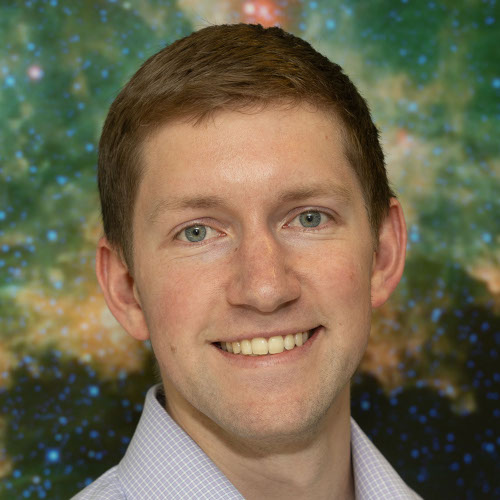
Corey Spohn
NASA Postdoctoral Program Fellow
NASA Goddard Space Flight Center
I'm an exoplanet researcher specializing in yield modeling and mission simulation for future space telescopes. I'm currently a NASA Postdoctoral Program Fellow at Goddard Space Flight Center, where I work with Chris Stark on coronagraph simulations and direct imaging yield studies for the Habitable Worlds Observatory (HWO). I also co-led the Visualizations Task Group for HWO's Exoplanet Science Yield Working Group.
I spend most of my time building Python tools for the exoplanet community. These include coronagraphoto for simulating realistic coronagraphic observations, yippy for PSF interpolation, orbix for extremely fast orbit propagation, and yieldplotlib for visualizing what different yield calculators produce. I'm also a core developer of EXOSIMS, an open-source mission simulation framework created by Dmitry Savransky.
I did my PhD at Cornell with Dmitry Savransky, where I worked on the Roman Exposure Time Calculator and developed methods to use radial velocity precursor data for scheduling direct imaging observations. Before that, I studied fluids and flying snakes at Virginia Tech-the snake research being responsible for my most memorable lab incident.
Research Interests
Direct Imaging Mission Optimization
- Mission yield modeling
- Optimal mission scheduling
- Forecasting planet observability
- Using precursor radial velocity for direct imaging
- Bayesian and information-theoretic approaches to maximize science gain
Simulating Exoplanet Detection & Characterization
- Coronagraph image simulation
- High contrast imaging/coronagraphy
- Radial velocity methods
- Integral field spectroscopy
- Habitable Worlds Observatory (HWO)
Computational Astrophysics
- Modular Python/JAX exoplanet software libraries
- Optimized solvers for Kepler's equation
- Coronagraph PSF interpolation via Fourier interpolation
- Exoplanet data visualization and animations
- Orbit fitting and parameter estimation
Education
Ph.D. in Mechanical and Aerospace Engineering
Cornell University
Ithaca, New York
- Thesis: Planning Direct Observations of Exoplanets with Precursor Data
- Advisor: Dmitry Savransky
- Minor: Astronomy
M.S. in Mechanical and Aerospace Engineering
Cornell University
Ithaca, New York
- Advisor: Dmitry Savransky
B.S. in Physics
Virginia Tech
Blacksburg, Virginia
- Minor: Mathematics, Astronomy
B.S. in Engineering Science and Mechanics
Virginia Tech
Blacksburg, Virginia
Experience
NASA Postdoctoral Program Fellow
NASA Goddard Space Flight Center
Greenbelt, Maryland
- Created realistic images and animations of HWO observation scenarios for multiple plenary speakers at the HWO 2025 meeting
- Led a study on how future direct imaging telescope's field of regard will impact the use of precursor science
- Member of HWO's Exoplanet Science Yield Working Group advisory committee and task group lead for the Visualizations Task Group
Ph.D. Candidate / Research Assistant
Space Imaging and Optical Systems Lab, Cornell University
Ithaca, New York
- Researched methods to improve yield of future exoplanet direct imaging missions through observation scheduling and precursor science
- Developed novel observation scheduling algorithm for directly imaging exoplanets detected with radial velocity
- Created 'RVtoImaging', a Python/C yield code simulating precursor RV data collection and direct imaging observation scheduling
Undergraduate Research Assistant
Nature Inspired Fluids and Interfaces Group, Virginia Tech
Blacksburg, Virginia
- Designed and executed experiments studying passive anti-frosting surfaces and inter-droplet ice bridging mechanics
- Created Python applications to accelerate research calculations and automate data processing
Team Leader - Robotics Capstone Project
Virginia Tech
Blacksburg, Virginia
- Led team meetings, coordinated programming efforts, facilitated communication, and resolved team conflicts
- Developed human-robot interaction model to predict crowd movements in response to robotic intervention during panic situations
- Built team of robots using pursuit-evasion algorithms and motion tracking to refine human-robot interaction model